Monday, October 11, 2010


Sunday, October 3, 2010
Down is up and so forth
Why does the IMF claim that contractionary fiscal policy is expansionary? Just a little evidence? Ah ... and how is the data constructed?
The Economist helpfully provides a guide for travellers to this very real universe of "important people."
Does fiscal austerity boost short-term growth? A new IMF paper thinks not
Sep 30th 2010
MOST people, among them the tens of thousands of workers who rallied in Brussels on September 29th, believe that fiscal austerity leads to a shrinking economy, at least in the short run. Jean-Claude Trichet, president of the European Central Bank, disagrees. In June he said that “the idea that austerity measures could trigger stagnation is incorrect.” Arguing that a credible fiscal-consolidation plan would restore confidence, he said: “I firmly believe that in the current circumstances, confidence-inspiring policies will foster and not hamper economic recovery.”
With rich-world budget deficits averaging about 9% of GDP in 2009—up from only 1% in 2007—and their average public-debt-to-GDP ratio expected to hit 100% by the end of this year, austerity is a bullet that few rich countries will be able to dodge. But is it right to claim, as Mr Trichet and other devotees of “expansionary fiscal consolidations” do, that belt-tightening can actually aid growth in the short term? The intellectual backing for these claims comes from a study by two Harvard economists, Alberto Alesina and Silvia Ardagna, which studied past fiscal adjustments in rich countries*. They found that, more often than not, fiscal adjustments that relied on spending cuts boosted growth, even in the very short run. But a new study by economists at the IMF reckons that the Harvard study was seriously flawed**. ...
The Economist helpfully provides a guide for travellers to this very real universe of "important people."
Does fiscal austerity boost short-term growth? A new IMF paper thinks not
Sep 30th 2010
MOST people, among them the tens of thousands of workers who rallied in Brussels on September 29th, believe that fiscal austerity leads to a shrinking economy, at least in the short run. Jean-Claude Trichet, president of the European Central Bank, disagrees. In June he said that “the idea that austerity measures could trigger stagnation is incorrect.” Arguing that a credible fiscal-consolidation plan would restore confidence, he said: “I firmly believe that in the current circumstances, confidence-inspiring policies will foster and not hamper economic recovery.”
With rich-world budget deficits averaging about 9% of GDP in 2009—up from only 1% in 2007—and their average public-debt-to-GDP ratio expected to hit 100% by the end of this year, austerity is a bullet that few rich countries will be able to dodge. But is it right to claim, as Mr Trichet and other devotees of “expansionary fiscal consolidations” do, that belt-tightening can actually aid growth in the short term? The intellectual backing for these claims comes from a study by two Harvard economists, Alberto Alesina and Silvia Ardagna, which studied past fiscal adjustments in rich countries*. They found that, more often than not, fiscal adjustments that relied on spending cuts boosted growth, even in the very short run. But a new study by economists at the IMF reckons that the Harvard study was seriously flawed**. ...
Friday, September 10, 2010
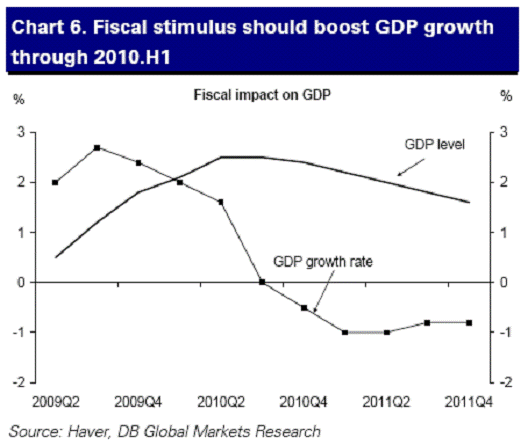
Kenynesian orthodoxy at work
It's not a surprise things are looking dicey right now. See http://krugman.blogs.nytimes.com/2009/12/27/stimulus-timing/ .
Friday, April 16, 2010
Tea Party History
With April 15th marking tax day and the Tea Party movement becoming more vociferous--but not necessarily more coherent--now might be a good time to discuss the historical and economic aspects of the Tea Act of 1773, which engendered the Boston Tea Party. Not only do modern-day Tea Partiers have their economics wrong, they have their history wrong, as well.
Great Britain imposed the Townshend duties in 1767 to recover some of their expenditures from the Seven Years War. These duties (or taxes) were levied on many goods imported by the colonies--glass, paper, paint pigments, and tea. These external duties (or tariffs), save for the one on tea, were all repealed by 1771.
Then in 1773, British Parliament passed the Tea Act. This was not, contrary to popular belief, an additional tax on imported tea. Rather it was a modification of the Navigation Acts--the laws that governed trade relations between England, the American colonies, and other relevant trading partners. The Navigation Acts stipulated that any product heading to the colonies, including tea, had to first pass through English ports, where it would be subject to an English tax. The Tea Act of 1773, however, allowed the English East India Company to directly export Indian tea to the colonies without having to be routed (and thus taxed) through British ports.
This act also had the effect of eliminating a lot of colonial middlemen--merchants and wholesalers, primarily--who profited greatly from the tea trade. Needless to say, the Tea Act reduced the incomes these individuals received. This, combined with the elimination of the tax levied on goods that passed through British ports, reduced the price of imported tea for the colonists. Since most colonists did not drink tea, this act had little economic effect on the average colonist. However, colonial merchants saw their economic position being undercut by British merchants who could now export tea to the colonies duty free thanks to the Tea Act. The Tea Act eliminated the need for colonial middlemen and reduced the price of tea by reducing tariffs.
Colonial merchants responded to what they rightly perceived as a threat to their main income source--managing the importing and exporting of goods--by organizing the Boston Tea Party. The party itself was small; only 30-40 merchants partook. It was short, as well; it only lasted three hours. Over $1 million (in 2008 dollars) of tea was dumped into Boston Harbor. British Parliament responded by further tightening its grip on colonial commerce by imposing the Intolerable Acts in 1774. (These acts were largely political in nature and had little to do with economics, hence the name.)
In summary, the Tea Act of 1773 eliminated taxes on imported tea. And the Boston Tea Party itself was led by wealthy, urban colonial merchants who saw their wealth destroyed due to the elimination if the tea tariff. In other words, modern-day Tea Partiers name their movement after a revolt led by wealthy urbanites (not "real" Americans) in response to a tax reduction. Just like their economics, Tea Partiers have their history wrong, as well.
Monday, April 12, 2010
Markets at work
Gotta love the work that "This American Life" is doing on the financial crisis:
Bet Against the American Dream from Alexander Hotz on Vimeo.
And for more on how this might work, from Ezra Klein's interpretation of a new paper called "Financial Innovation and Financial Fragility" (pdf), Nicola Gennaioli, Andrei Shleifer, and Robert Vishny:
Bet Against the American Dream from Alexander Hotz on Vimeo.
And for more on how this might work, from Ezra Klein's interpretation of a new paper called "Financial Innovation and Financial Fragility" (pdf), Nicola Gennaioli, Andrei Shleifer, and Robert Vishny:
... the game runs like this: Investors want to make more money with less risk. Someone invents a financial product that appears to make investors more money with less risk -- in this case, subprime securities. Demand for this new product explodes. But few understand this new product, and even the people who do understand the new product don't know how it performs under stress (it's a new product, after all). At the beginning, this actually helps the product: because its risks aren't known, they're ignored, and so it looks like a better deal than it is and sells more of itself than it should.Then something bad happens. The new product shows its flaws. And precisely because no one really understands it, the market cracks. Investors all run away at once, as they don't really have the tools to assess the situation. Where lack of knowledge about the product originally drove demand, now it accelerates flight.
Subscribe to:
Posts (Atom)